Episode Transcript
[00:00:00] Speaker A: Welcome to Woowooville, the next stop on your spiritual journey, hosted by two fellow travelers who found a soul connection on the path to higher consciousness.
Our goal is to help you navigate the choppy waters you're likely to encounter on the spiritual path by sharing our experiences with you each week.
Join us as we spill the tea on what it is like to wake up to your authentic self.
Hello. Hello, I am Lola Singer with my favorite co host.
[00:00:29] Speaker B: Hello, I am Ameril.
[00:00:31] Speaker A: And for those of you who are new to the podcast and even to those who have listened for a while, just a reminder, we initially started to help people who were new on the spiritual journey, and we were kind of thinking to ourselves, what's a topic we may have overlooked that people want to know about on the spiritual journey? And I'm almost a little embarrassed that we didn't do this one before.
Do you want to tell them what it is?
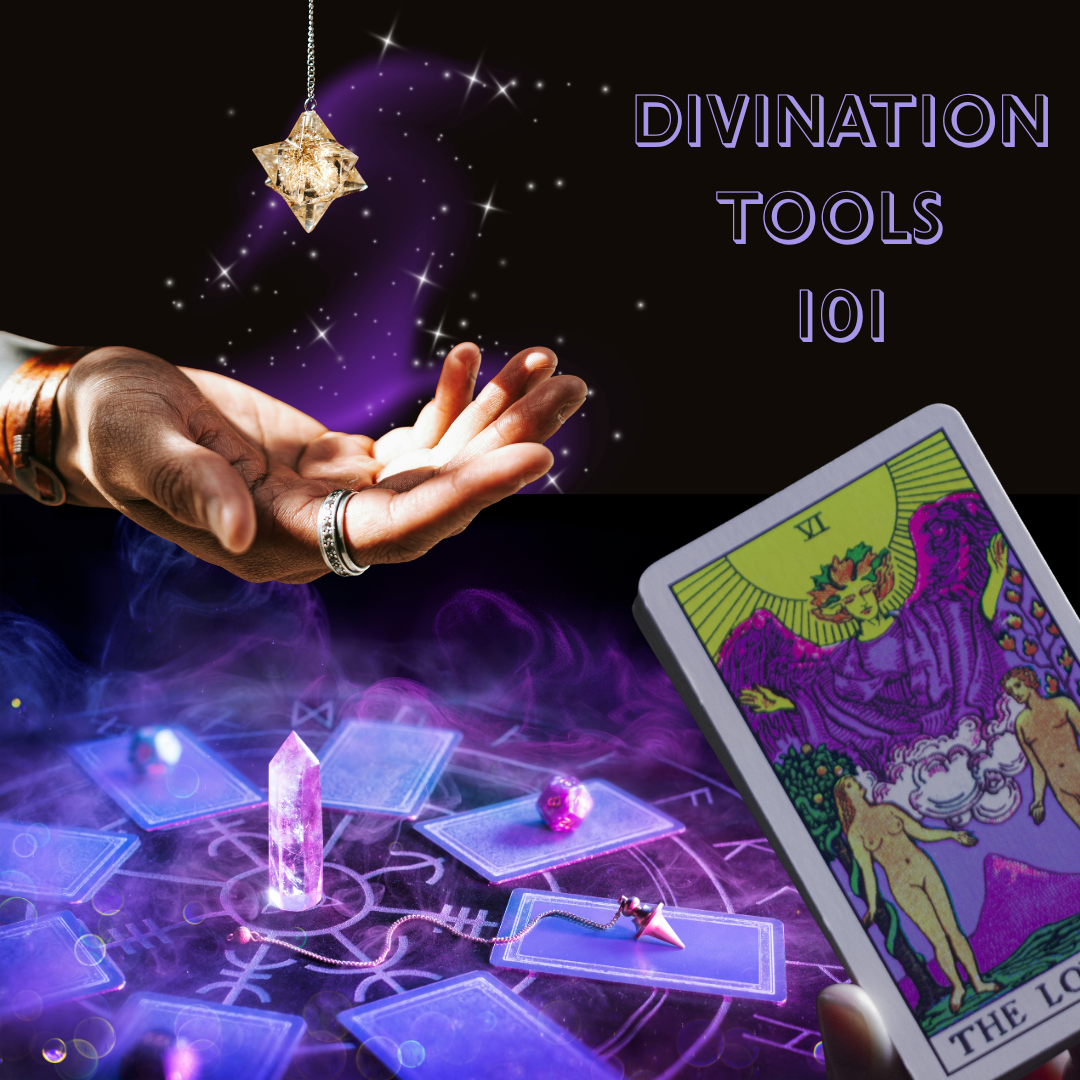
[00:00:57] Speaker B: Yeah, It's Divination Tools 101.
[00:01:02] Speaker A: So there's going to be a wide variety of divination tools. We're going to go through a list of some that a lot of them are cultural based and we want to respect everybody's culture as we go along. So if we accidentally mispronounce something, that's why.
But divination tools are something that a lot of people use on the spiritual journey.
If you're not quite sure what we mean about that, just think something like pendulums.
[00:01:27] Speaker B: Yeah.
[00:01:28] Speaker A: Oracle cards. Now you guys get the idea.
[00:01:31] Speaker B: Yep.
[00:01:32] Speaker A: So what do you want to say anything before we dive in?
[00:01:35] Speaker B: Well, I think we should bring into the first question.
[00:01:38] Speaker A: Well, before we do, let them know that I use divination tools all the time.
I'm Lola Singer and I read Tarot using the Toth tarot deck. And I have been studying esoterics and tarot with the Same teacher for 15 years.
Go deeper and deeper and deeper and deeper and deeper.
So I would like to say that I love tarot as a divination tool and other people love their divination tools too. So in this episode, you might find out about something that you're really going, wow, that is cool. I would like to explore that more.
So that's exactly what it's about. I hope you get as much joy from your divination tools as I do from the tarot deck.
[00:02:19] Speaker B: Yeah.
[00:02:20] Speaker A: Okay, now let's dive in. What do you want to say first?
[00:02:23] Speaker B: All right, so the first question that pops out is, why are people drawn to divinations in the first place? Which is a Great question.
[00:02:33] Speaker A: Well, and when you think about it, divination means divine, right.
So you're trying to get answers, but you want to get the answers right. You want to get it from. Straight from source, if you can. Right. So it's a way.
But I think the divine, if you kind of bring it down a notch, it's more of a way to tap into your own subconscious.
So you are connected and.
Yeah, you want answers.
How do we say this politely? You can't always get the right answers from your friend, can you?
[00:03:08] Speaker B: Yeah.
[00:03:10] Speaker A: So that's why you want a tool to help you out.
[00:03:12] Speaker B: Yep.
[00:03:14] Speaker A: So what are the kind of situations where somebody might be drawn to reach for a divination tool?
[00:03:21] Speaker B: So some of the things listed is first uncertainty, which we know that can really.
[00:03:28] Speaker A: That's the main reason I see for tarot readings. You know, it's like, you know, especially if you, you know, you, you know, you've got a couple options, you've been weighing them. You know, you might have an inkling which one might be better. But sometimes to use one of your tools helps you confirm what you were already thinking. How's that?
[00:03:45] Speaker B: Yep.
Which is. The other one is decision making.
[00:03:49] Speaker A: Oh, I guess I skipped ahead to that, didn't I?
[00:03:52] Speaker B: Yeah.
[00:03:54] Speaker A: And wanting confirmation. I guess I addressed that in that scenario too, didn't I?
[00:04:00] Speaker B: And last but not least, wanting to feel guided.
[00:04:03] Speaker A: Yeah, it does. That's exactly because it's divination. It gives. Gives you a feeling of connection to something greater.
Yeah.
[00:04:10] Speaker B: So then we want to ask ourselves, are we looking for guidance or reassurance?
[00:04:16] Speaker A: That's where it gets tricky, because I think sometimes people are waiting and waiting and waiting to get confirmation for what? The answer that they want.
So they might like, let's say you're using a tool like the runes, for example.
You might keep throwing the runes over and over till you get the answer you want. That's not how it works, people. That's not how tarot works. That's not how pendulums work. No, no, no, no, no. And I've taught enough tarot classes where I had to caution the students about that, you know? Well, I don't like that. So I'm going to do another reading. No.
So, yes, you do need to ask yourself, am I really looking for guidance or I'm just trying to get the answer. I want to hear the reassurance.
So what is divination?
We have a definition. Do you want to read that?
[00:05:11] Speaker B: Yes. So the definition for divination is a tool for insights, a Way to see patterns.
And it's not about fixed outcomes.
[00:05:25] Speaker A: I'm really important. The part about not about fixed outcomes is on there because, number one, we have free will. Right.
So when I do a tarot reading, I tell people, this is showing us what's likely to happen if you keep going the way you are. And I would apply that to any divination tool. This is what's likely to happen based on who you are at the moment. But you could wake up, have an epiphany, and change your mind tomorrow, and that would change the trajectory. That'd be like a time jump, right?
[00:05:55] Speaker B: Yep.
[00:05:56] Speaker A: A perspective change.
So in my training, I know there's going to be other people who are going to argue with me about this, but in my training, it matches this definition.
Tarot does not tell you the future. It tells you where you're headed naturally, based on where you are right now. Now, that said, there's probably practitioners of other divining tools or even tarot who say, yes, it does. It tells the future.
Use your discernment people.
All I'm saying is, in my training, this definition makes sense to me that it's not about a fixed income outcome. It's about what's likely to happen if you keep going the way you are. Because there's too many factors that influence the future.
[00:06:38] Speaker B: And other things are that divination actually is. Is a pattern recognition.
[00:06:46] Speaker A: Well, that's for sure. With, with tarot, you're looking for patterns. You're looking for how the planets line up, because each tarot card is aligned to a planet. You want to see how the elements of Earth line up. You want to see how the zodiac signs line up. So that's all on the tarot cards. But there's other divination tools where you're looking for patterns. For sure, we'll talk about them. But like, here's an example. Like when people throw the bones, like in the bayou in Louisiana, right.
They're looking at the pattern that the bones are making.
[00:07:20] Speaker B: The second one is externalizing intuition.
[00:07:25] Speaker A: I'm going to say that means that it means you already had an inkling of what was going on, and that helps you to understand that your intuition was right. Is that how you're perceiving that?
[00:07:35] Speaker B: I would think so, yeah.
And last is using a system to see something.
[00:07:42] Speaker A: It does help to have a visual, doesn't it?
[00:07:43] Speaker B: Yep.
[00:07:44] Speaker A: Instead of just keeping all in your head or even in your heart sometimes if I see it, I can understand
[00:07:53] Speaker B: it better when it's a way of structuring your thoughts, too. Because I think if you just get overwhelmed with overthinking and over processing something, you're just kind of like you're going all over the place instead of having that clear, more clarity through situations.
[00:08:12] Speaker A: Yeah.
And what I like. I'm sorry, I'm going back to tarot, because I know it so well. But with tarot, you can get a bigger picture. You can ask a question that's going to give you a lot of information to work with, or you can ask something as simple as yes, no, maybe, you know, so it all can be addressed.
And. But once again, I think what we want to keep emphasizing is use your discernment about the answers.
Because only you know in your heart if it makes sense or if it does not.
Does that help at all? Mm.
So you took some tarot classes from me. How did you like it?
You still read the cards, don't you? From time to time, yeah.
[00:09:00] Speaker B: I liked it. There's like, a lot of information that clears out. Or sometimes, like, when you're overthinking something, it just. It's a good tool to get to what you're wanting to clear out.
[00:09:16] Speaker A: Yeah.
So how did I first discover tarot? Well, I was new to the spiritual path, just like the people we're talking to in the audience.
And I was curious. And there was a center in Seattle, a spiritual center, teaching classes. And I was actually afraid of tarot. I didn't want to take it, but the center was closing, and that was the last class they were gonna offer. There I go. Do I want to let them close and not take advantage of the last class?
So I decided that I would address my fears. Cause there's a lot of misconceptions about tarot. And I'm so glad I did, because really, I did find out.
It does help you tap into your subconscious and shine a light on things that were hidden.
And so I think a lot of times people think it's scary and spooky. And I did too, because, you know, it's got a bad rep. You know, when you look at old 1930s horror films. Right.
[00:10:15] Speaker B: Even current ones, there's been current tarot scary movies being done.
[00:10:21] Speaker A: Yeah. And really, it's just. I always. I tell people it's just a conversation between you and your higher self, which I guess is what all divination is. I should have said that earlier.
All divination, in my opinion, is a conversation with your higher self.
[00:10:34] Speaker B: Yeah.
[00:10:35] Speaker A: It's not scary.
Anything that you want to add to that and in your experience with anything that you've used?
[00:10:45] Speaker B: No, I think you kind of covered everything.
[00:10:48] Speaker A: Okay, well, let's go through the list of divination tools, because some of these are. You'll be familiar with, and some of them be like, well, I didn't know that existed. And maybe one of those ones where you say, I didn't know that existed. You're going to go, wow, I want to learn more about it.
So why don't you start with the first category? Amaral.
[00:11:05] Speaker B: So the first category is Card Based Systems.
[00:11:08] Speaker A: And number on the list, of course, is Tarot.
[00:11:11] Speaker B: Yeah.
So there's Tarot, which is a structured deck with archetypal imagery.
[00:11:18] Speaker A: Well, the archetypes would be 90% of the time, when you see a person on a Tarot card, it's representing energy. So they're showing energy in the form of a human representation. But there are 16 cards that represent real people and personalities.
So I think that's what they're talking about as far as the archetypes go.
And then there's Oracle cards, which a lot of people use. There's a system to Tarot, there's certain properties and rules to follow. But with Oracle cards, it's pretty much anybody can write anything they want on an Oracle card. And that said, I've seen some really good readings with them.
So they're more intuitive and less structured than Tarot, that's for sure.
And you've used both.
And do you feel like you've gotten good readings from both type of cards?
[00:12:11] Speaker B: Yeah, it just seems like.
It seems like Tarot is right down to the point. And Oracle cards are a little bit more loosely.
[00:12:20] Speaker A: Well, this is something the audience might know. There is a system to the tarot.
It's based on ancient metaphysical science. And yes, I'm using the word science. Meta means beyond, beyond physical science.
So these are the things that people studied, the alchemists. And so we're talking about relationships that are about how do I turn lead into gold, Lead being the body, earth and gold being the sun and the spirit.
How do I get there? So there's a structure to the tarot. There's something called the Kabbalistic Tree of Life. If you line up the cards to this diagram, that's ancient, they happen to line up perfectly.
So it's more of a system and it's more of a scientific approach to divination, whereas Oracle cards are more of a freeform kind of approach.
And as I said, I've done a lot of fairs, and sometimes when it's quiet. We'll do trades with each other. So I might trade a tarot reading for somebody who does an oracle reading. I've gotten some good oracle card readings, so I think it's really just what floats your boat.
But be prepared if you want to study tarot. It's more complicated than oracle cards, that's for sure.
There's also the Lenora Mont cards, which are a system that I think is based on tarot. They've been really popular and they're very direct and practical and symbolic. They. They showed up in the 19th century in Europe, honestly, because I love my deck so much, the Toth deck. I do not know a lot about the Lenora Mond cards.
Lenormand cards, but I know they're extremely popular.
So if that's something that intrigues you, you can look into them. I'll spell it for you. L E N O R M A N D.
And then you can also.
Also, you just use a playing card.
Sorry. Playing deck of cards. Right.
That's called cartomancy. And that's just like a regular deck you'd use to play poker.
[00:14:36] Speaker B: Yeah.
[00:14:37] Speaker A: And then like Tarot, you know, has the four elements of earth, fire, water, air, and earth. The spade, the club, the heart, and the diamond line up to those as well. Like the diamond is earth, which makes sense. Diamonds come from the earth. Right.
[00:14:56] Speaker B: It's funny because I've done the lookup before of like, what is. What would. What poker card would we consider.
What's this poker card in Tarot cards. And it'll tell you the translation if you.
[00:15:08] Speaker A: That said, though, there's only 52 cards in a regular poker deck. There's 78 in a tarot deck.
So they're not going to line up perfectly.
[00:15:18] Speaker B: Yep.
[00:15:19] Speaker A: Okay. So there's another type of divination tool which are the ones that give you, yes, no answers. And they're directional tools.
So the first one on the top of list. You guys are going to know this one. Do you want to tell them what it is?
[00:15:33] Speaker B: Yeah. Pendulum was a weighted object giving directional answers.
[00:15:39] Speaker A: So I don't know what you know about pendulums, and once again, I am not an expert on them, but I've used them.
And one of the things that I didn't know till I was talking to someone at a fair, one of the other people giving readings, is that you need to clear your pendulum every time you ask a question.
Do you know that?
[00:16:02] Speaker B: No, but I kind of automatically already clear mine every single time before I use it.
[00:16:06] Speaker A: Well, I guess here's what they might not know the audience because I didn't is that, let's say it's Tuesday and you ask a yes, no question that's really obvious to be sure what the yes is and what the no isn't.
So let's say like my favorite question to ask in that is am I a rhinoceros?
Right. Because I know the answer to that. So if it points left, you know, when I ask that, then that's, that's the no. Correct.
But on a different day on Wednesday you could ask the same question and it will point to the right when you ask if I'm a rhinoceros.
So I'm telling you guys this because I didn't know. Every day is different. You need to check with you. That's what you need to do first.
Ask an obvious yes no question to make sure you know for sure that that's the yes or the no for the day. I guess for certain people though, maybe if you work with your pendulum more and more and more it becomes more consistent.
But I'm just letting you know, just because it pointed yes to the left on one day, it might not on another. So you got to always make sure you're calibrating it.
[00:17:18] Speaker B: Then the last one is the bobber or slash ring on a string.
[00:17:22] Speaker A: I have never heard of a bobber.
[00:17:23] Speaker B: Simple pendulum variation. I have.
[00:17:28] Speaker A: Have you seen one?
[00:17:29] Speaker B: Yeah, but it's a simple thing as like a necklace. People take down their necklaces because it has a string.
[00:17:35] Speaker A: Oh yeah. I used to use my, my.
[00:17:37] Speaker B: It's very old school.
[00:17:38] Speaker A: I mean employee ID as a pendulum sometimes.
[00:17:42] Speaker B: Not that.
[00:17:42] Speaker A: I mean, could that be called a bobber?
[00:17:44] Speaker B: I guess. Yeah. Because it's a form of it. Yeah.
[00:17:48] Speaker A: Okay. And so you can ask yes, no, maybe you can set up a grid that you know, kind of.
[00:17:54] Speaker B: Because I've seen that being done too.
[00:17:55] Speaker A: Yeah. Where, where you have different things like north, south, east, west, all kinds of things on. You can buy grids for the, for the pendulum to point out.
[00:18:05] Speaker B: I've been shown how to do percentages too with pendulum.
[00:18:08] Speaker A: Oh, like you could ask, is there a 90% chance that you know.
[00:18:12] Speaker B: No. Like show me how much percent like, like for example, like some person has healed on their.
I'm spacing off how much work have they done on their core traumas? And it gives you an average. Like it doesn't, it's not in a
[00:18:29] Speaker A: set thing but it's just so you can buy these pre printed discs or even a paper that the pendulum could point to or the bobber. I guess we did miss one here. That's really important, too. That is actually really fun. That's dowsing rods.
Dowsing rods are. You hold them in your two hands and they spin when you ask a question.
Same thing with the pendulums. You want to determine what's yes or no before you start a session. But then you can ask all kinds of yes no questions and it'll move one way for yes and another way for no.
So people really like those, too.
And you might have seen those on TikTok or places like that.
Okay, so what's the next category is Symbol casting systems.
So there's a popular one on the top.
[00:19:24] Speaker B: Yep. That's the runes, which is Norse symbols cast or drawn by Elder.
[00:19:31] Speaker A: No, Elder and Foolhard examples of the runes. So they look like a cryptic language.
And when you throw them, each stone has the symbol has a meaning.
So the person is looking for the combination to get the story of the different runes working together as a pattern.
You've seen those, right?
[00:19:57] Speaker B: Yeah.
[00:19:59] Speaker A: This is something I've never seen. And I'm going to spell it for you. First.
Ogham staves, O, G, H, A, M.
And then the plural of staff, S, T, A, V, E, S, ogham staves. And those are Celtic and they're a tree Alphabet that's used for divination. So I'm assuming it's very similar to the runes but using trees rather than.
And I assume there's symbols on those, too, and you're looking at how they all work together.
Do you want to read the next one?
[00:20:31] Speaker B: Yeah. It's a charm casting, which is tossing of small objects. Charms and reading the layout.
[00:20:39] Speaker A: Yeah. Now they do that. I know in hoodoo, and I actually used to watch someone who did this on Facebook and she was just a really pleasant person. She just put all the charms that she liked and made sense to her. So I don't think there's a set of charms that you put in. It's whatever kind of gives a message to you.
So they almost look like little Monopoly game pieces, if you can picture that. And they could be like things they've just gathered along the way. One might be plastic, one might be resin, another might be metal. But they're familiar with the objects in their bag. And when they throw it, they understand the story.
At least that's how I've seen it.
And then. Do you want to read the next one? Yep.
[00:21:24] Speaker B: Bone casting or ostomancy. Is that how you spell?
[00:21:30] Speaker A: Well, since English is not your first language, Osteomancy which means bones.
[00:21:37] Speaker B: Bones or objects interpreted by position.
[00:21:41] Speaker A: So I know they do this in the deep south too, with the hoodoo. But think about it. This has got to be the first.
Doesn't it have to be the first form of casting bones?
This has got to be how all our ancient ancestors started. Don't you think?
[00:21:56] Speaker B: Probably. I would think so.
[00:21:57] Speaker A: I'm sure this happens in Africa. I'm sure it probably happens everywhere. Australia, Europe, South America. I can't imagine one culture that wouldn't have started this way.
It may not have developed into their favorite form. You know, like the runes are favorites of the Norse. But how could it not have started with casting bones?
[00:22:17] Speaker B: Yeah.
[00:22:18] Speaker A: So anyway, once again, you're just looking at the patterns once you throw them.
Okay. And then there's other ways of reading patterns. Do you want to tell them the first one?
[00:22:28] Speaker B: Yeah. Pattern reading, form based tea leaf readings, which is tassiography, tasiography patterns and tea leaves.
[00:22:39] Speaker A: Yep. So my understanding of this one is you have someone drink the tea and then when you get to the bottom, you know how the little tea leaves stick to the bottom of the cup or even to the sides of the cup.
And then the person who's the tea reader is looking for interpretations based on the image that he or she's picking up.
Have you ever seen that being done?
[00:23:01] Speaker B: Yeah, I have seen it being done.
[00:23:03] Speaker A: Okay. And it's really similar to the next one. One which is coffee grounds readings.
And apparently. Well, that makes sense. You know, there's tea readings in certain cultures and that it turns out the coffee ground readings are more tied to the Middle east, but basically the same thing going on. And especially like, have you ever had like a cup of Turkish coffee that's really dark and you know that will leave a little residue at the bottom of the cup.
Now here's one I didn't know about, but until there's someone I met recently who does this, but I didn't know about it. It's called wax reading and that's ceromancy. And you melt the wax and then I guess you drip it and then you're looking at the shapes that form.
So kind of like the tea reading, they're interpreting what they pick up on the ship. But guess what?
I could be wrong because it could be just letting the candles burn down on their own and seeing what happens with the wax. I think it probably could go either way. I'm not an expert on this one, but I do think it's fascinating that it exists, don't you okay, do you want to read the last one on the list?
[00:24:16] Speaker B: Yep. Smoke reading.
Capnomancy, which is interpreting smoke patterns.
[00:24:22] Speaker A: Now that's fascinating.
I haven't met someone who does that yet.
[00:24:28] Speaker B: No, I haven't either. But I mean, I've just, like, when I hear it, immediately I think of smoke signals that the natives used to use.
[00:24:36] Speaker A: Yeah, yeah. And they literally read those.
And I do a tarot reading. You know, when I first wake up in the morning and I light two candles and I love when it's still dark and I blow the candle out and I watch the smoke rise from one candle and then I'll blow out the other and watch it.
That does feel like a connection to the divine when you watch the smoke.
Yeah. And of course, a lot of cultures treat smoke as sacred for that reason, because it connects you to the divine for sure.
Okay, now this is one I know you've done before.
So the next category is scrying. And that's going to be a vision based version of divination.
And this is kind of stereotypical, but people do use them. Crystal balls.
Gazing into a crystal ball.
And then the people are looking for impressions or reflections in the surface to give a reading. I think that takes a lot of skill and practice. I bet.
I don't think many people can afford a true crystal ball anymore, but I do. There is a woman in Seattle who has a really big one, Robin.
And I think it's. It's like kind of like those ancient skulls.
It's got a consciousness in it.
So that would be really interesting to scribe with that one.
[00:26:07] Speaker B: Yeah.
[00:26:08] Speaker A: And you've done this. Do you want to tell them about the next one?
[00:26:10] Speaker B: Mirror. Mirror scrying, which is often black mirrors,
[00:26:14] Speaker A: usually a black obsidian mirror. You can buy those online.
So you're gazing into the darkness, which is the subconscious. Mm.
[00:26:27] Speaker B: I don't. Well, I've used black mirrors before, but I feel like a regular mirror works a lot easier for me.
And.
Well, mirrors are portals, so. So because of that, you're able to connect to depending on what your questions are and what you're trying to get out of it.
This one's a strong one for me as far as being able to get answers, but it's just very interesting how they. How it comes in, because it's more for me. Like, I just.
I noticed that when it works the best is when I'm not.
I'm not trying to push the answers out. I'm literally going a phase of complete, just like, peace and just calmness and I ask the questions through my mind. Meaning, like what? Like as I'm looking in the mirror and automatically start getting the answers.
[00:27:22] Speaker A: Well, and I think that there's another way to do it too, which is the way that my teacher talks about it. I have a black mirror, and he has me set up the tarot card facing the black mirror, because we're looking into the darkness, which is the subconscious and the unknown.
And you'll see the tarot card in a different way that way.
So that's what we do. And I think that with the mirror scrying, not only is it just getting feedback like you are, but I think you kind of go into this.
If I understand it right, you're kind of going into a trance, and things start to feel like they're moving. So, like, the tarot card could start. Look like it's moving slightly, or if you're looking into the black mirror at your own reflection, it could start feeling like it's moving. So I think that's what they're looking for too.
What's the movement? Where's the direction? What does this possibly mean?
Yeah, and that goes hand in hand with the next one, which is water scrying, which is gazing into still water, which you could do definitely outdoors. But most people use a bowl. And oftentimes for the same reason as the mirror scrying, oftentimes a black bowl, but not always. It doesn't have to be. And so you're gazing at your own reflection and you're calm, like you're talking about the mirror. And when you're calmer, things are kind of more likely comfy. But you're right, a water bowl is also portal, isn't it?
So.
And oh, my gosh, the next category. People do this all the time, but they probably don't even realize they're scrying, do they?
[00:28:57] Speaker B: Yeah.
[00:28:58] Speaker A: When they're outdoors, do you want to tell them what it is?
[00:29:01] Speaker B: Fire gazing?
[00:29:02] Speaker A: Yes. So you could gaze at a flame. But I don't know how many people I've seen, my dad was one of these, who would just get. Get lost looking at a fire. You know, like, so somebody's got a campfire, they're around the campfire. They. They just can't take their eyes off of it. They get mesmerized.
They're probably getting answers because. And they're relaxed. But this. But the scrying itself, be watching the flames.
So I think, number one, people just in general tend to get mesmerized and calm with the fire.
But number Two, they're doing the same thing they're doing with the coffee grounds and stuff. They're looking for shapes. They're looking for this jump. Does it look like this, this jumped this flame?
[00:29:43] Speaker B: Does it look like that it's interpreting the flames?
[00:29:46] Speaker A: Yeah.
Okay, so do you want to talk about the next one?
[00:29:50] Speaker B: Yep. Numbers and structure systems.
So first we have the numerology, which is a meaning derived from numbers, birthday, and name.
[00:30:00] Speaker A: Yep. So I bet a lot of people have done this for fun. You know, you write out your name and then you. Each letter is associated with a certain number, and then you find out what your name is. And sometimes it tells you what your, you know, your. Your master's journey, for example.
So I love. I think numerology is really fun. And there's a system to it. And you break down the numbers. Like if it's a double digit, you know, two plus three would be five, so it wouldn't be 23. Anyway, there's rules to it. It's fun. I like numerology.
But the next one is something I have not seen, but it's geomancy, and that's looking at patterns of dots and marks that form symbols. And it says it's something based out of Africa and the Middle East.
So I don't know how they make the patterns or the dots or the marks. But if it's in a. If it's a system about numbers and structure, I'm almost wondering if, like, each one has different number of dots. I mean, I don't know how they generate the dots.
Do you know anything about this one?
[00:31:07] Speaker B: No.
[00:31:08] Speaker A: Okay, people, I'm going to spell this for you if you want to look into geomancy. G, E, O, M, A, N, C, Y.
Now I'm kind of intrigued because I'm wondering. Yeah, I get it, that there's dots and marks, but how do you. How do the dots and marks appear?
Okay, well, something for us to look into.
[00:31:27] Speaker B: I was confusing that one with the one that's coming up, but I'll talk about it once it comes up so it doesn't get confused.
[00:31:32] Speaker A: Well, I think we're ready for it. What's the next one?
[00:31:34] Speaker B: Cosmic Astrological Systems.
[00:31:39] Speaker A: So people are going to know the first one. Astrology.
[00:31:41] Speaker B: Yeah. Which is Planetary positions and cycles.
[00:31:45] Speaker A: Yes. So most of us know our European version. Right. Like I'm a Gemini, you're a Scorpio, and we have different traits based on the planetary position that were when we were born and the place we were born.
And then there's different Systems. There's the 13 calendar system. There's also Chinese, there's Mayan, there's all kinds of astrology ways to work with astrology.
So was that what you were talking about? Is what we were heading to? Okay, then go. Feel free to speak on.
[00:32:22] Speaker B: So the next one is the horary. Horary Astrology, which is a chart that casts for a specific question.
I don't know about that one. I was going to talk about the next one.
[00:32:39] Speaker A: Well, I think I've seen astrology charts posted. It's not always the birth chart.
People are asking what's likely to happen on a certain day too, aren't they? Yeah, so I think that's what they mean with horror read. That's my guess anyway.
[00:32:54] Speaker B: Yeah, I think so too.
[00:32:55] Speaker A: This happened when this planetary alignment happened, you know, most recently.
You know, there was a war, for example. You know, they could be saying something like. Or there was a lot of babies born. Whatever they're looking at. Okay, all right, let's. Let's go with the one you were heading toward.
[00:33:14] Speaker B: So astro cartography, which is mapping planetary lines on Earth. It goes a little more specific though. It's about marking a lines or leyline. Sorry, not a lines. Ley lines on Earth to find out information such as in which places of the world you should be living, which places, according to your astrological alignment, you would have more joy. Which places in the world you would succeed more in your job or on finances, et cetera, et cetera. So it's like a mapping of going down the ley lines and the energetic connection with your alignment with the astrology to find out where you would be, depending on what you're trying, what you're focusing on, like let's say you're focusing more joy. Then you would go to certain places to live at. Because the line, the energy there, it's catering for.
[00:34:11] Speaker A: Compatible for you.
[00:34:12] Speaker B: Exactly.
[00:34:13] Speaker A: It also lets you know where you're not likely to do well.
[00:34:15] Speaker B: Exactly.
[00:34:18] Speaker A: Think twice before you move there.
[00:34:20] Speaker B: Yep.
[00:34:22] Speaker A: Okay. And then there's body based systems. So one that's really obvious is palmistry. We're looking at the hand. Right. Chiromancy is what it's called.
So person who does that is reading lines and structures of the hand. But I think what we're not seeing there is, it's like, it is like tarot, because certain fingers represent certain days of the week. Certain parts of the fingers represent months, other parts represent zodiac.
So anybody who reads palms, kudos to them. I think it's almost a science
[00:34:59] Speaker B: I have never had my palms read. I have gone to places where I've seen palm readers, and I'm always like, oh, I need to check it out. And then I always, like, spaced it off or something happens where I don't align with it.
[00:35:10] Speaker A: That said, there's different levels of palm readers. Just like there's different levels of people who are doing any of these.
So I've had very thorough palm readings from people, but I'm just using example because it's kind of a joke and I wasn't being charged for it. But in London, I went to visit my brother, and my brother's gay, and the way they set up certain clubs in London, you have to be a member to get in.
So he took me to a gay club that you had to be members, and I was the only woman there, and that's fine with me. I love gay guys. So I was there having fun, and this man walks up to me and he's really drunk. He goes, I want to read your palm.
And it's like, okay.
And he looked at my palm. He goes, you're very open and understanding of others. And I was just laughing to go, I'm the only woman in a gay club. How hard was that to figure out that was funny Red in my palm?
It's like I laughed because sometimes that is not. To me, that was just like. Really?
Yeah. Did you actually read my poem?
So anyway, that's just an offbeat story.
Okay. What's another one?
[00:36:36] Speaker B: Face reading. Interpreting features and expressions.
[00:36:39] Speaker A: Yeah. I think with face reading, they're even looking at, like, how we have asymmetry to our face.
They're looking. Yeah. I don't know how people do that.
I even have a friend, Leanne, if she's listening. Leanne Lister, who reads people's prompts, but she also looks at their hangnails. Because she told me if they have hangnails on certain parts of their fingers, that means something.
But I mean, that's how I would. Like, what else are they looking at when they're looking at faces? If she's looking at hangnails, you know, there's so much on a face.
[00:37:12] Speaker B: Yeah.
[00:37:14] Speaker A: And then another category we've got on that is body dousing, which is using the body responses as signals.
So a good example of that would be, I think they call it muscle testing. Right.
Where you ask, just like the pendulum, you have a yes or no question, and first you do your test question. Mine is, am I a rhinoceros? And then you notice when you're standing if you move slightly forward or slightly backward, if on that day you're moving slightly forward, then that's the no. Right. Because you're not a rhinoceros. But just like with the pendulums, if on the next day you ask the same question and you feel yourself moving slightly back, that's a different story. That's why you have to test it first every time before you ask the real questions.
And then that's all you do.
You stand and then you ask yourself the next question and you notice. Okay, is it a yes or no? Based on my rhinoceros question? First I know which direction yes or no is today. And then you start asking questions and all you're doing is you're noticing your body shift. That's just one example I've done.
There's other ones you can learn about, too. Are you familiar with that?
[00:38:23] Speaker B: No.
[00:38:24] Speaker A: Yeah. I would say it's called muscle testing more than body dousing.
Now with body based systems, I have another interesting scenario.
This has been a couple years, but one of the people at one of the fairs actually read people's feet.
So people had to take their shoes and socks off.
So I don't know how people get trained on these things, but they do.
Okay, do you want to read the next category?
[00:38:52] Speaker B: Yep. Object based psycho.
[00:38:56] Speaker A: Psychometric.
[00:38:57] Speaker B: Psychometric.
[00:38:59] Speaker A: So psychometry is reading energy from objects you've heard.
[00:39:02] Speaker B: You've done that, I've done that.
[00:39:04] Speaker A: You've done that. Like someone hands you. Like you don't know the person and they hand you keys or their ring or something. Especially energy on those.
[00:39:11] Speaker B: Especially with metal.
With metal jewelry, which, when I got my elephant, I had to clear it right away because I knew that I didn't want anyone's energy to be on.
[00:39:24] Speaker A: Not even the nice people from Drum Circle.
[00:39:26] Speaker B: Well, yeah, but at the same time, you want it to be clear because you're using it. Why would you want somebody else's energy on your things?
[00:39:31] Speaker A: Fair enough. Fair enough. Yeah. So. But it doesn't even have to be metal. People can do it with other things, too.
[00:39:37] Speaker B: That's true, too.
[00:39:38] Speaker A: It could be a ribbon from someone's hair. I think a lot of mediums work that way.
[00:39:42] Speaker B: It's just easier with metals because metals attract the most energy.
[00:39:46] Speaker A: Yep, exactly. And then another one's bibliomancy, which is opening a book randomly for guidance. I did have someone do that with me for reading. When I did a trade for someone, she had a book of healthy foods, I think it was, or like old, old remedies with healthy foods. In it like an old timey book. And that's what she did. She. She just opened the book, put her finger down and go, you need to eat more berries.
So I have experienced that one and this one I've never heard of. Sortilage casting. Oh, casting lots. That's what it's called. Sortilage ancient method using marked objects. That'd be like throwing a dice.
Sortilage. Who knew?
Okay, so do you want to talk about some of the cultural ones?
[00:40:36] Speaker B: Yep. Cultural traditional systems. So the first one is throwing shells
[00:40:42] Speaker A: and in particular cowrie shells, which are considered a symbol of the divine mother in these regions. I do know that.
[00:40:50] Speaker B: So used in African and Afro Caribbean traditions.
[00:40:54] Speaker A: Yep.
[00:40:55] Speaker B: This is really. I'm really familiar with that one. Because they use it in Santeria. Yeah, they use it in Santeria. I have an X that was a santero, so he used to use them.
[00:41:05] Speaker A: Yeah. But the shells themselves are considered sacred, so they treat them with a lot of respect.
Okay. IFA divination, which should be tied to the Yoruba system.
And it uses palm nuts or chain. It says chain.
[00:41:25] Speaker B: Chain.
[00:41:26] Speaker A: What is that?
I understand palm nuts and I've seen them.
Okay, well, since I'm not from that culture, I'm just going to respect that.
I don't know if it's the chain. Like we're thinking in English chain.
[00:41:42] Speaker B: Yeah.
[00:41:42] Speaker A: But definitely they're using.
And Santeria is based on Yoruba.
[00:41:48] Speaker B: Yeah, it is. Because Yoruba is one of the.
One of their deities.
[00:41:54] Speaker A: Okay. And then people are probably familiar with this one. I Ching, Chinese symbols using coins or Euro sticks.
And then I understand concept, how that works. You throw it and then there's a book that shows all the diagrams of the possible combinations. So you throw it and then the practitioner. I don't know how they memorize it because there's a lot of them. But when I had it done, the person was looking through the book to find the exact diagram and message that matched what got thrown. So I have had that.
And do you want. Do you read the next one?
[00:42:27] Speaker B: Thai Bet and mo divination or mu divination.
[00:42:32] Speaker A: I think it's. It says mo, so I'm associated. I'm assuming it's mo.
[00:42:35] Speaker B: Mo.
[00:42:36] Speaker A: And that looks like it's another dice based system which neither of us are familiar with. I apologize. I love Tibetans, but I do not know this one.
And then another would be Sybil Oracle traditions which are based on ancient Greece and Rome. And that's a trance plus a symbolic interpretation which is Kind of like what we talked about, how some people are with the fire. Right.
So the oracles, which is interesting because you didn't know this Greek and Roman was that the oracle of Delphi, which is very famous.
The reason that those oracles were so respected is because they actually were on a harness hung over a crevice and out of the crevice gases were coming.
So they were basically going into trance state because of these gases and then they would deliver messages.
[00:43:31] Speaker B: That's probably not healthy, but I mean,
[00:43:34] Speaker A: I don't know how long lived each oracle was, but that's how they connected to the divine. They were in a different state of consciousness.
[00:43:43] Speaker B: That's very interesting because. Well, I'm gonna have to look into that because there's something there for me. I could feel it.
[00:43:51] Speaker A: Okay, so now here's some categories you might not think about, but that came up for us and that would be sound and language based divination.
So the first one on the list is light language and tonal expression, which is intuitive sight.
Sorry, Intuitive sound for insight or regulation.
Now honestly I have not used it for insight, but definitely for regulation.
I intuitively make sounds that I can feel shift in my body.
But there's different kinds of light language.
And some people see symbols and that I can definitely see would be intuitive sound because it's kind of like they'll see a symbol like the runes. Right. It may not be a rune, but they'll see a symbol and symbols carrying an energetic frequency. And I can see where they might get insights that way.
[00:44:50] Speaker B: I'm surprised to hear that, that you don't like do the intuitive, the insight
[00:44:55] Speaker A: ones because I've told you a million times, cl. Clear. Visual is not my clear.
[00:45:00] Speaker B: What I meant is in the way where like. So for example, let's say a person was there and then I think you already do it, but I don't think you realize it because it comes so natural.
What it is, is like for example, let's say you're doing a healing on someone, right? And you start with a healing and then all of a sudden you're gonna use a, A sound healing for their feel, their body. Exactly.
[00:45:20] Speaker A: And you're right, I don't even think about.
[00:45:22] Speaker B: Yeah, I was gonna say you're already doing it. What are you talking about?
[00:45:24] Speaker A: It's like, it's. I guess you. It's like when you telling people that they know how to tie their shoe.
That's apparently you're right. I guess I do. Oh, thank you for the insight.
[00:45:34] Speaker B: Yep.
[00:45:36] Speaker A: This One. You know about automatic speaking or writing? Oh, yes. Words or symbols emerging spontaneously.
[00:45:43] Speaker B: I have filled so many journals with that, so many journals with that. Because sometimes, like messages can just come briefly and sometimes it can be like six pages long.
[00:45:53] Speaker A: And often some people channel. They just channel through automatic writing. Somebody else is speaking to them.
But for you it's more like a connection to your higher self. Yeah, yeah. I'm glad they included symbols here because when I try to do automatic writing and I start in English, it always turns into light language symbols.
Now, granted, I can feel them, but it's kind of frustrating because I'd like to be able to read the message, but I can't give it a literal translation. Like the people who can just write in English.
[00:46:28] Speaker B: Yep.
[00:46:29] Speaker A: Okay, and how about the next ones? Because these are things that are quite fascinating.
[00:46:33] Speaker B: Yeah. Nature based systems.
[00:46:36] Speaker A: So the first one is augury, spelled A U, G U, R Y. And what is that?
[00:46:42] Speaker B: Observing birds, which comes from ancient Rome.
[00:46:47] Speaker A: So I guess I would assume they're watching their patterns, how they're moving.
That would be my guess.
[00:46:55] Speaker B: That's interesting because I feel like I connect. I'm very connected to the birds, but I'm through their singing, like when I wake up. And if they start singing a certain way, I can always tell things that they're trying to.
[00:47:06] Speaker A: Well, maybe that's what it is too. Maybe it's just both.
[00:47:08] Speaker B: Yeah, maybe it is both because I was like, I definitely can connect with the birds singing because it's very distinct. And with singing, if a bird starts, others will join or the same kind would come in.
Yeah. So it's quite interesting.
[00:47:26] Speaker A: Okay, now this one. I didn't know about weather patterns. Some people interpret natural shifts in the weather. Oh, that's when people feel like the rheumatism's in my knees. So the storm's coming. Is that what they're talking about?
[00:47:39] Speaker B: I would assume, you know, like a
[00:47:40] Speaker A: grandma would say that Asma. Rheumatism. That means the weather's changing.
[00:47:44] Speaker B: Maybe.
[00:47:45] Speaker A: Yeah, I'm guessing that's what it is, but it's probably even more sophisticated than that too.
[00:47:49] Speaker B: Yeah.
[00:47:50] Speaker A: And the next one is stone reading, which is selecting or casting stones.
[00:47:54] Speaker B: I have heard of this.
[00:47:56] Speaker A: Yeah, I guess that would be like, without the runes on them.
[00:47:59] Speaker B: Yep.
[00:48:00] Speaker A: And then what's the last one?
[00:48:01] Speaker B: Tree or plant omens, which is interpreting natural science.
[00:48:06] Speaker A: Well, that makes sense. We probably did that to survive.
So you start noticing, you know, a plant is bent a certain way, Things like that.
Is that what they're talking About. I think so, yeah.
[00:48:18] Speaker B: Oh.
[00:48:18] Speaker A: Or classic example would be like when the curved branches of trees come together. So you know that's like a fairy ring probably.
Yeah.
[00:48:27] Speaker B: Or when the trees naturally start like doing like spiral circles which tells you that there is a vortex formation of an energetic vortex.
[00:48:36] Speaker A: Yeah, that's I think what I was. Yeah.
Yes. And then I remember our friend Justin showing me some photos where he could read how things were structured around trees to tell me that the fae had been there. So some people have these abilities.
To me it was like, okay, point that out to me again. I'm not sure I'm getting it. But he, he. It was very natural to him.
[00:49:03] Speaker B: The last one is internal non tool worth.
That's worth mentioning. So one is intuitive sensing, which is direct knowing without tools.
[00:49:15] Speaker A: Yeah, well, that's when you're trusting your gut, I think is what they're trying to say there. Right.
[00:49:19] Speaker B: Well, intuitive sensing is. Also comes. It's a.
It's a gift. I forgot the name. But it's inner knowing, clear cognizance. Yeah, that would be technically intuitive sensing
[00:49:31] Speaker A: and then dream interpretation. I know some dream interpreters. Symbolic guidance through dreams.
I think you can do that yourself as you get more familiar with your own way that your psyche likes to interpret things.
[00:49:49] Speaker B: Also, I think like you said, the more you really go within and really study yourself, you can see patterns as far as what your subconscious is really trying to tell you because you already know things that you're working with. So the dreams is just either like, for example, for me, I can interpret dreams really easily after I do like big healings because they immediately go into like telling me like what has been done or if there's anything left for me to do.
[00:50:19] Speaker A: Okay. And the last one's very visioning or inner imagery, which is spontaneous symbolic perception. To me that kind of sounds like an inner journey, like a shamanic journey, you know, like the animals come and join you and you're walking with the animals. Or it could be a glimpse of some. Something that is symbolic.
Yeah. So anyway, there's a lot more forms of divination than what you probably thought there.
[00:50:45] Speaker B: Yeah, that was a lot.
[00:50:47] Speaker A: So we just have a few minutes left and we wanted to talk about some of the things to be aware of when you're. When you're using divination tools.
And the most important one we talked about earlier, asking the same question repeatedly and trying to force an answer and not trusting the first reading. These are things that we recommend you not do because you're just trying to get.
You're not taking the cards seriously. You're not taking the pendulum seriously.
And if you consider this a conversation with your higher self, basically you're saying, I'm not taking my higher self seriously.
What's the next one that you.
[00:51:28] Speaker B: Using tools to avoid decisions. What should I do? Or outsourcing responsibility.
[00:51:37] Speaker A: That sounds to me like trying to procrastinate and not. Or not get the answer on or what should I do? Well, yeah. Yeah. I guess it's more like you're giving more power to the tool than you are to your own input that you're getting.
[00:51:58] Speaker B: Yeah. Because even I feel like anyone, whatever, like if they're getting a reading and using whatever it is, whatever tool divination, if you're really tuned into yourself, you can feel it with whether it's a truth or not.
[00:52:13] Speaker A: So I think this is just saying maybe just to try to avoid substituting it for that.
And yes, and exactly. It's a tool. But you are you.
Okay. Another thing to avoid is reading while you're emotionally activated or charged.
Because anxiety distorts interpretation. That's just simply because we're not thinking clearly.
[00:52:32] Speaker B: Well, that in.
When you're going through a lot of chaos and you are actually, like, embodying that chaos, like, meaning, like, that is part of you.
If you're going to do any readings, it's going to be based off of, like, where you're at. So if you're trying to read someone and they're like, in more of a balanced frequency, the reading is going to be off.
[00:52:54] Speaker A: And when I do my own readings, if I'm anxious, I'm more likely to get cards. Like a disappointment and defeat and things like that. Yeah.
Also, I keep hearing this in my head, so maybe somebody needs to hear it. It's kind of like, you know, you don't drunk dial your ex. That's not a good reason.
Don't drunk dial the divination tools.
[00:53:15] Speaker B: I also feel like this is part of, like, following, like, being disciplined about, like, doing things correctly or treating it with respect. Yes.
Because if you're not feeling well, why would you think that you're going to do the greatest reading?
[00:53:29] Speaker A: Okay. This is probably the best one on the list. Do you want to read out of things you should avoid?
[00:53:34] Speaker B: Yep. Becoming dependent, needing a tool for every decision.
[00:53:40] Speaker A: Yes. At some point, the tool stops helping and starts replacing your own judgment.
Then you have given away your power, haven't you?
[00:53:49] Speaker B: Yep.
[00:53:51] Speaker A: Okay, so what's a good reading? Like, what does it feel like?
Well, I love It. I love it. And I love seeing people having a good reading for me because you can see the aha moment you see when something clicks or when you're doing it for yourself, you feel it when it clicks, no matter what tool you're using.
And what's the next thing that might be a good. Tell you what good reading feels like
[00:54:16] Speaker B: clarity or not Confusion.
[00:54:19] Speaker A: Yeah. If it's causing more confusion, you've asked the cards too many times, probably. Right. But if it's like once again, like an aha moment, it's like, oh, it starts to make sense now. That's when you know it's a good reading. You know it's also a good reading. I've noticed when I'm at fairs when the tears come.
So if, because it hit home, it. And these are more like tears of recognition than they are of sorrow. So if I look around at a fair and I do see that somebody with someone else in the tears have started, go, wow, they must have really had a good reading.
And a good reading is not always what you want to hear, so be prepared for that.
I've had good readings for myself where it wasn't what I want to hear because it gives you a different perspective and different way to approach things, a different way to look at how things are going. And I think that works for pretty much everybody. I imagine you've had reading where you heard something, you went, I didn't want to hear it, but it hit song.
[00:55:26] Speaker B: Yeah. Well, especially in the very beginning because we're so clouded by everything that we get readings. We're like, what?
But it makes sense.
[00:55:35] Speaker A: Yeah. So that's a good reading. It's so different than the reading that hasn't really hit the mark because if you're over reading or the interpretation feels muddy, that's very different than a good reading. So a good reading does not overwhelm you. It clarifies.
So the relationship between your tools, whatever tools you like, you do still need to ask yourself, do I need the tools at all?
And some people use tools as training wheels to help develop their internal awareness.
And then they use them for a while and then they step away from them. I've seen that a lot.
They start to trust their inner self a little more.
That said, as long as you treat them as tools, I think you're fine to keep using them if you want to, but as. As long as you don't, you know, give away your power to them or think they're greater than you or my tarot teacher says.
Exactly. With the cards, these are tools.
[00:56:43] Speaker B: Yeah.
[00:56:44] Speaker A: Anybody can touch the tools, but there are other readers who've been taught. Nobody's allowed to touch my cards. They're sacred. So it just depends on your viewpoint. I see them as tools.
Okay, so the goal is not to rely on the tools, it's to help sharpen your own awareness. Yep. Use them respectfully, but do not. Once again, do not give your power away.
Okay, so some examples, someone might ask about a relationship, Someone might ask about a decision.
Someone might ask what will happen.
But you have to remember, like we talked at the beginning, these are indications of what could happen.
It's never set in stone. So if you, if you do a reading or you use your pendulum or whatever form and you get an impression of what, what's likely to happen, and then you tell yourself this is going to happen, you're going to set yourself up for a fall, like especially with relationship, oh, there's a man in my future.
And then you just, you know what that does? It's like a self professing, self perpetuating thing where people go to a party and go, I saw in the cards that there's a man coming. Could that be the man? Could that be the man?
Could that be the man? So those are the things we want you to watch out for. And that said, that's our travel down the divination highway.
[00:58:17] Speaker B: Yeah, it was a long travel. So don't forget to share with someone. Thank you for tuning in.
[00:58:23] Speaker A: Bye bye.